
Diagnostics and radiology.
For radiology departments, X-ray centres and practices whose dose values, examination protocols or quality assurance need specialist review. WiseRay carries out constancy testing, dose optimisation, work with diagnostic reference levels and the development of your protocols. You can outsource individual tasks as a project or arrange ongoing medical physics support. You work directly with the person responsible for the specialist work.
 CT and dose management in daily clinical practice
Dose, image quality and testing obligations under control.

Diagnostics and radiology
WiseRay works in conventional radiography, CT, mammography, diagnostic fluoroscopy and interventional radiology. The services you need depend on your equipment, range of examinations and tasks already covered internally.
- Conventional radiography, CT, mammography and diagnostic fluoroscopy
- Interventional radiology in the radiology department; for operating theatres and cardiac catheterisation, see Area 2
- Dose quantities, diagnostic reference levels (DRLs) and protocol optimisation
- Image quality, constancy testing and quality assurance
- Equipment procurement and optimisation
- Introduction and evaluation of dose management systems
Related links: Dose and process optimisation · Constancy testing · Dose management in the wiki (DE) · CT protocol review in the wiki (DE)
When an initial consultation is worthwhile.
A new CT scanner or interventional system is being introduced.
WiseRay supports procurement, commissioning and the setup of examination protocols through to the transition into clinical operation.
Dose values stand out or vary widely.
Diagnostic reference levels are systematically exceeded, outliers occur, or equipment and sites produce different values.
Protocols have evolved or remain unreviewed.
A structured protocol review considers the clinical question, scan range, acquisition, reconstruction, image quality and dose together.
An audit or self-assessment is approaching.
We prepare you for the clinical audit or annual internal self-assessment, with a comparison of requirements and current practice (gap analysis) and a quality manual.
QA and constancy testing
Quality assurance is not yet fully organised.
Services for your project or your ongoing support.
We define the scope for your facility. Technical testing, dose analyses, documentation and training can be combined.
Audit and documentation
A QuickScan gives you a prioritised overview of the action required. More detailed support also examines whether documented processes are actually implemented in daily clinical practice.
Constancy testing and technical quality assurance
Constancy tests reveal changes from a documented reference state. WiseRay performs these tests and supports your staff with the checks carried out within your facility.
Dose and process optimisation
Dose optimisation starts with the diagnostic information required. WiseRay therefore reviews image quality and exposure together with the responsible physicians and radiographers.
Structural radiation protection
For new buildings, renovations or equipment replacements, WiseRay supports room planning and calculates the shielding for the planned room and equipment arrangement.
WiseRay Academy and training
WiseRay combines interactive online courses with on-site or hybrid training. The content is aligned with your team’s tasks.
How we approach dose and protocol questions.
Depending on the assignment, we combine the following steps. You can find the common starting point under How we work together.
Baseline assessment
We review the licence, equipment inventory, QA documents, protocols, DRL evaluations, dose data and responsibilities. The result: a reliable baseline.
Data and protocol review
Harmonise examination types, analyse typical values and outliers, compare with DRLs. The result: a prioritised list of items to “retain”, “review” or “optimise”.
On-site review
We observe clinical workflows, operating practices, equipment geometry, scan range, protective equipment and interfaces.
Measures and evidence
We document recommendations, responsibilities and implementation steps, and reassess their effect after introduction.
Explore the topic before we speak.
 CT protocol review: systematically optimise dose Why CT protocols drift from their original version over time and how a structured review using dose data, clear responsibilities and documented decisions leads to demonstrable optimisation. (DE)
 Dose management Turning individual dose values into a manageable process: how a dose management system collects data, compares it with reference values and translates it into meaningful optimisation. (DE)
 DRL process in practice Turn diagnostic reference levels into real optimisation: the cycle of recording dose, comparing it with the DRL, adapting protocols and checking the effect. (DE)
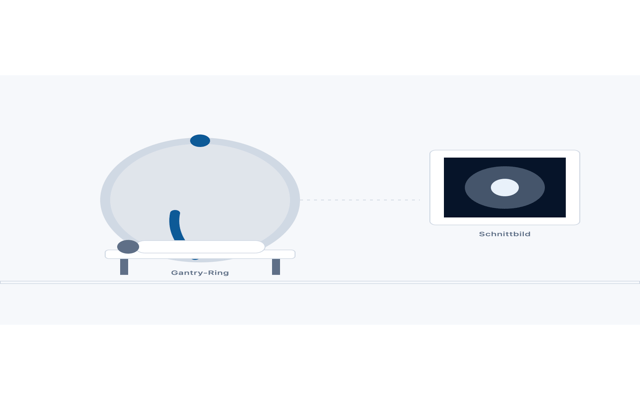 Computed tomography: technology and dose From rotating beam to cross-sectional image: how CT reconstruction works, what CTDIvol, pitch and DLP mean, and how protocol parameters interact. (DE)
 X-ray diagnostics: image formation How penetrating radiation forms an image: the principle of attenuation, the digital imaging chain, the difference between radiography and fluoroscopy, and why dose and image quality always belong together. (DE)
 Clinical audits What a clinical audit is, how it differs from an inspection and why it is less a control exercise than a structured tool for improving the use of radiation. (DE)